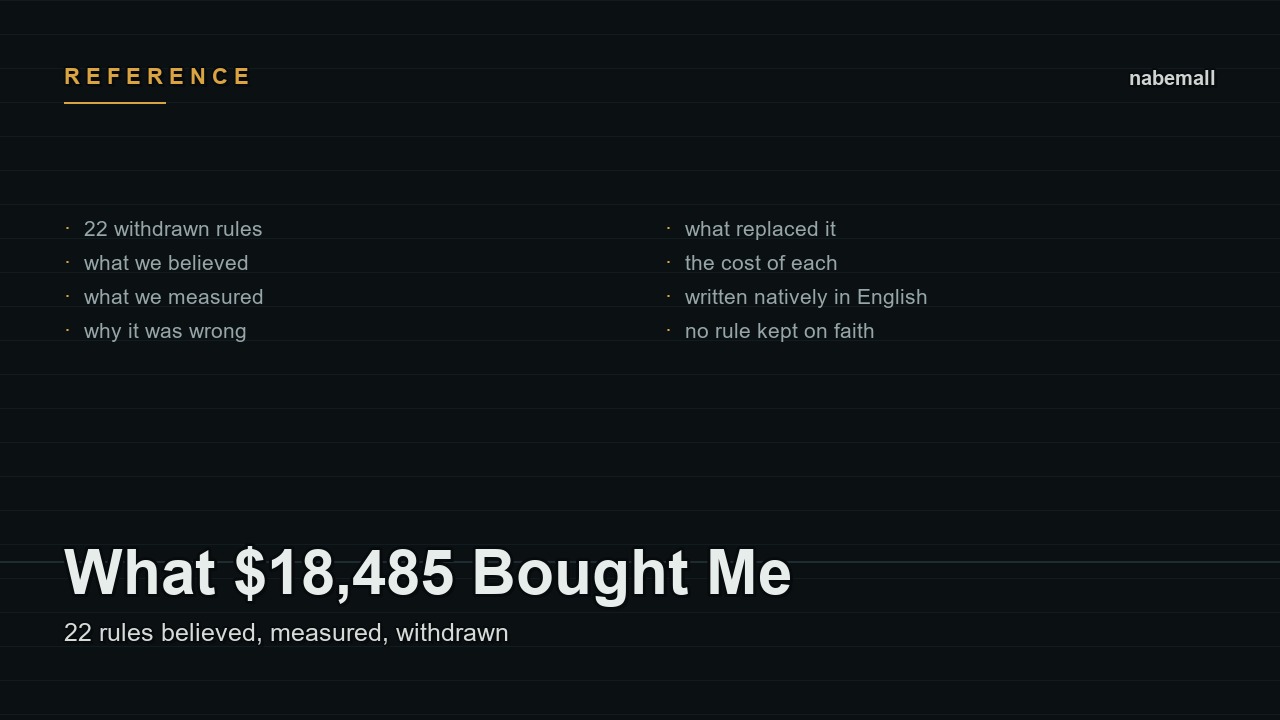
What $18,485 Bought Me — 22 AI video rules I believed, measured, and withdrew
Twenty-two prescriptions adopted into a production standard and then killed by measurement, each with what I believed, what I measured, what it cost, and what I do now.
Twenty-two prescriptions adopted into a production standard and then killed by measurement, each with what I believed, what I measured, what it cost, and what I do now.
What is in it
- README.md — read this first
Claims, and how to check them
- the archive contains 3 files
check: list the zip; this count was read from it
What it does not do
- not a program — nothing here runs on its own
- generation credits are your cost
- no guarantee of an outcome, and no revenue is promised
You need already
- nothing to read it
- your own generation credits to run anything in it
files: 3formats: jpg, md
Twenty-two rules I believed, wrote into a production standard, and then had to withdraw.
Every AI video guide is a list of things that worked for someone. None of them tell you what that person tried first, how long they believed it, or what it cost to find out they were wrong.
That second list is the expensive one. A success recipe can be copied off a blog in ten minutes. A refutation has to be bought with credits — and then it has to be noticed, because the output is plausible either way.
WHAT EACH ENTRY LOOKS LIKE
What I believed → What I measured → What it cost → What I do now.
Nothing is theoretical. Every one was a prescription already adopted, usually already written into a standard, before a measurement killed it.
A FEW OF THEM
• I scored the source image instead of the composite. Concluded 6 of 22 frames were unusable. Measured on the actual composite: 21 of 22. A metric pointed at something the renderer does not produce gives confident wrong answers.
• Fourteen samples elected the wrong winner. Clean ladder, unambiguous result. At 73 cases the winner failed on one — exactly the rate you cannot see in fourteen.
• "Japanese anime style" produced a Western face. Twice. A style label is a hint; anatomy is an instruction, and whatever you leave unsaid the model decides for you.
• I asked for space to put a title, and the model wrote the title. Misspelled. Then the typesetter printed the real one on top of it.
• I did not know the billing units differed. 147 of my own cuts landed in a dead zone where half of what I paid for was discarded at the edit.
• I assumed my own marginal cost was zero and built a pricing strategy on it. It was not zero. It was invisible.
• My own leak scan missed my own leak — caught by a gate at line 4,909 of a 741 KB file.
HOW IT IS ORGANISED
Six sections, grouped by the kind of mistake rather than the specific rule, because the category outlives the tool. A model version will make one entry obsolete; "a style label does not override a default you never contradicted" will still be true.
• Measuring the wrong thing · What you don't write, the model writes for you · The money is decided upstream of the money · The platform is not what the documentation says · Process · Judgement
WHO THIS IS FOR
Anyone running AI video production at enough volume that being wrong costs real money. If you have never had to withdraw a rule you published, this will read as pessimism. If you have, it will read as a list of things you nearly did.
HONEST NOTICE
• These are measurements on one account, in one period, on specific engines. Models change behaviour between versions — sometimes reversing it. Treat every entry as a procedure to re-measure, not a fact.
• Several entries are about my own carelessness rather than about the tools. Those are left in deliberately; they are the ones most likely to be yours too.
• No vendor is named where a claim could read as an accusation.
• Delivered as a single Markdown document. No video, no software, no templates.
• You may quote and build on this with attribution. You may not resell or redistribute it.