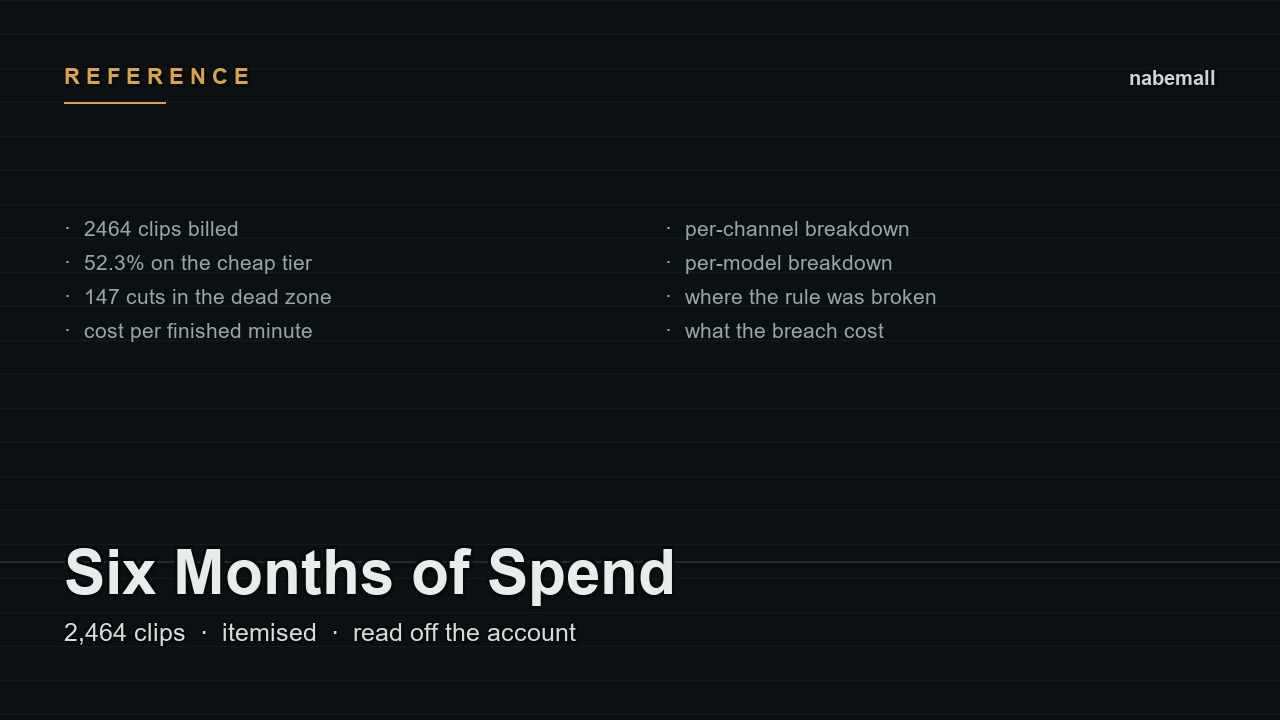
Six Months of Spend — what $18,485 of AI video generation actually bought
A spend statement drawn from 159 published episodes: 2,464 clips, tier distribution, measured credit rates, and the billing dead zone that wasted 147 of our own cuts.
A spend statement drawn from 159 published episodes: 2,464 clips, tier distribution, measured credit rates, and the billing dead zone that wasted 147 of our own cuts.
What is in it
- README.md — read this first
- episodes.csv — included in the package
- figures.json — included in the package
Claims, and how to check them
- the archive contains 5 files
check: list the zip; this count was read from it
What it does not do
- not a program — nothing here runs on its own
- generation credits are your cost
- no guarantee of an outcome, and no revenue is promised
You need already
- nothing to read it
- your own generation credits to run anything in it
files: 5formats: jpg, csv, json, md
Every cost article about AI video is an estimate. This is a statement.
$18,485 in generation credits, one account, six months — read out of the build folders of 159 published episodes. What was ordered, which engine each cut went to, and where the money left without buying anything.
WHAT IS IN IT
• The documented total, and an explicit list of what is not in it
• 2,464 generated clips across 159 episodes — with the median, and the range
• 1,275 cuts broken down by declared motion tier and the engine each routed to
• Measured credit rates per model, as ranges rather than as a single misleading figure
• The billing dead zone, with a count of how many of our own cuts fell into it
• episodes.csv — the per-episode table, so you can check the medians yourself
THE NUMBER THAT MATTERS
A median episode is 11 clips. That is the unit to budget in — not "a video", which in this corpus means anything from 5 clips to 55.
WHY THERE IS NO DOLLAR-PER-CLIP FIGURE
What a credit costs depends on which top-up it was bought in, and that is not something this account can document. So it is not published. You get the measured credit counts and you price them with your own rate — the arithmetic is yours to finish, and it will be correct.
Publishing an invented exchange rate would be the one unverifiable number in a document whose entire claim is that its numbers are measured.
IT INCLUDES THE PART THAT WENT BADLY
Our own rule says a normal episode should come out clearly majority cheap-tier. This corpus came out at 52.3%. Nearly half the cuts were declared dynamic and sent to a fixed-unit engine.
That number is left in. A spend statement that only shows the parts that went well is an advertisement. The useful finding is not a figure to copy — it is that the tier is decided at the script stage, by whoever writes "the animal charges" instead of "the animal watches", long before anyone looks at a price.
147 of our cuts also landed in the billing dead zone, where roughly half of what you pay for is thrown away at the edit. Writing them one second shorter would have cost nothing.
HONEST NOTICE
• Generation credits only. Tool subscriptions and older invoices no longer on file are excluded, so the real figure is higher.
• Rates are what this account was billed on these models in this period. Vendors change pricing; re-measure before you rely on them.
• Delivered as Markdown, JSON and CSV. No video, no software.
• You may use these figures in your own planning and quote them with attribution. You may not resell or redistribute the document itself.