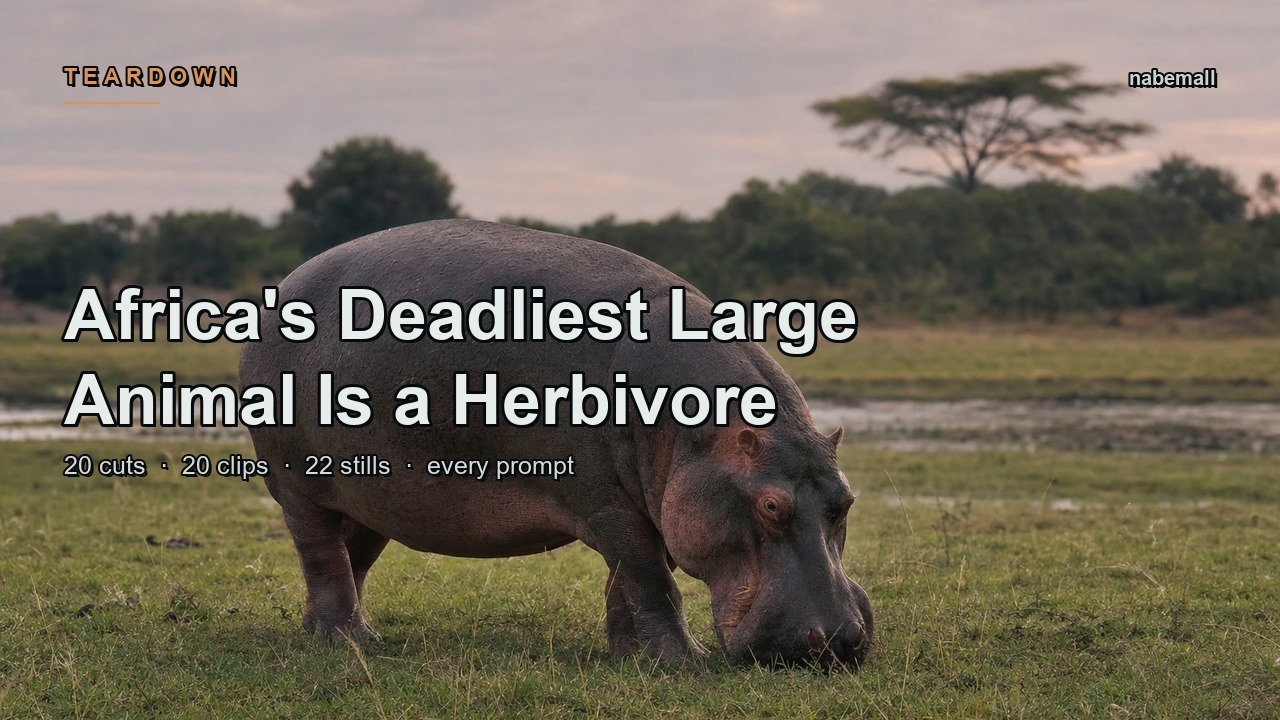
Teardown — Africa's Deadliest Large Animal Is a Herbivore: 20 cuts, film + clips + every prompt
20 cuts across 2 motion tiers, 90% on tier 1. A six-minute episode, published, with every generated clip (20), every source still (22), and the exact still and motion prompt behind each cut.
One published episode opened up: the finished film, 20 generated clips, 22 source stills, and the prompt behind each of its 20 cuts.
What is in it
- film/ — the finished episode — the published cut, exactly as it went out
- clips/ — 20 generated clips — every shot before the edit, including the plain ones
- stills/ — 22 source frames — the image each clip was animated from
- PROMPTS.md — one block per cut across all 20: framing, tier, still prompt, motion prompt
- production.json — the same record machine-readable, one object per cut
Claims, and how to check them
- every one of the 20 cuts has its prompt included
check: count the blocks in PROMPTS.md, or the objects in production.json - the archive holds 20 clips and 22 stills
check: list the zip; these counts were read from it - the episode is published and watchable before you buy
check: the listing links the public cut
What it does not do
- narration and on-screen text are Korean; the prompts and all documentation are English
- clips are re-encoded for download, not master bitrate
- no guarantee of a result — model behaviour changes between versions
- not a template: this is one episode, not a reusable standard
You need already
- nothing to read it — markdown, JSON, MP4 and JPEG
- an i2v generator and your own credits, to re-run anything
clips: 20cuts: 20format: midformnarration: Koreanstills: 22tier_split: dynamic:2 / low_motion:18
Every AI video tutorial shows you the prompt that worked. This shows you all 20, including the dull ones.
One published wildlife documentary — a six-minute episode — opened up. The finished film, all 20 generated clips, the 22 stills they were animated from, and for each of the 20 cuts the exact still prompt and motion prompt that produced it, beside the engine tier it was ordered on.
Watch the published cut before you buy: https://youtu.be/qnqGvfvnK80
WHY THIS GENRE IS WORTH TAKING APART
Animals are where identity drift shows first. A prompt that names the species loosely gives you a hyena in cut nine.
Every still prompt here carries a species lock written as a positive count — ear shape, coat pattern, toe count — never as a list of things the animal must not be.
WHAT IS IN THE PACKAGE
• The finished film, as published
• 20 generated clips — the raw shots before the edit
• 22 source stills — the frames each clip was animated from
• PROMPTS.md — one block per cut: framing, tier, still prompt, motion prompt
• production.json — the same record, machine-readable
THE ROUTING, IN THIS EPISODE
Cut split: 18 on tier 1, 2 on tier 2. Tier is assigned before a cut is ordered, and it decides the engine. A static shot on the expensive engine is pure waste; a hard-motion shot on the cheap one costs more, because the re-order costs more than the correct order would have.
WHAT THE EPISODE ARGUES
아프리카 최다 인명 살상 동물로 꼽히는 하마는, 사실 밤마다 풀 40킬로그램을 뜯는 완전한 초식동물이다. 사람을 잡아먹으려는 게 아니라 '물'이라는 자기 공간을 목숨 걸고 지키기 때문에 죽인다. (보너스 반전: 피처럼 흐르는 붉은 땀은 피가 아니라 천연 자외선차단제이자 항균제 — 히포수도릭산.)
THREE THINGS YOU CAN READ STRAIGHT OFF THE PROMPTS
• Identity is locked with a positive count, never a negation — a forbidden thing tends to get summoned.
• Framing is stated as what fills the frame, not as a shot-size name. Shot-size vocabulary is interpreted loosely by every engine we have measured.
• Subject, action and environment are separate lines in the motion prompt. Collapsing them into one sentence is where drift starts.
HONEST NOTICE
• The narration and on-screen text are Korean. Every prompt and all documentation is in English — the prompts are the transferable part.
• Clips are re-encoded for download, not delivered at master bitrate. They are reference and working copies.
• You may use these files in your own commercial and personal work, including client work, and modify them freely. You may not resell or redistribute the package itself, in whole or in part, as a product — including uploading the clips to a stock library.
• This is a record of what one episode took, not a guarantee of a result. Generation models change behaviour between versions, sometimes reversing it, so treat the routing as a procedure you can re-measure rather than a fixed ranking.