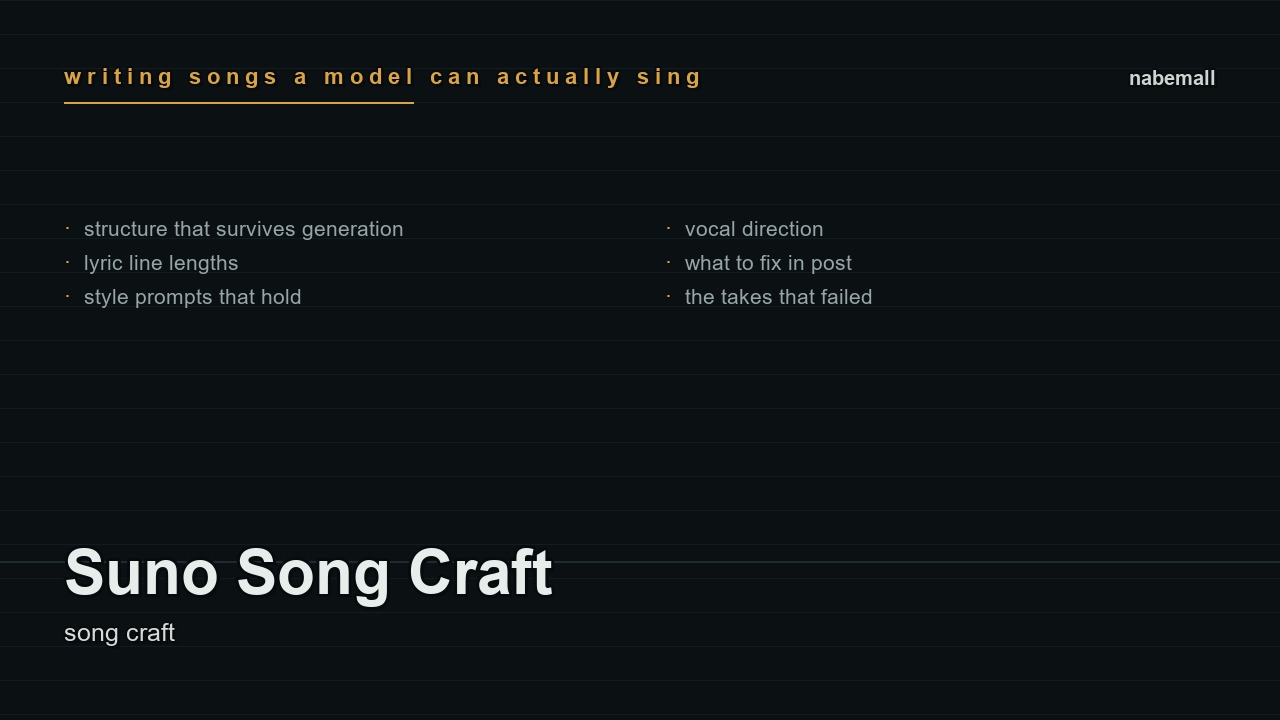
Suno Song Craft — the production standard behind released albums
Nine Claude Code skills for Suno: the 281-tag lyric dictionary, the parameter trap that makes tracks sound like AI, and the release ordering that cannot be undone.
Nine Claude Code skills for Suno: the 281-tag lyric dictionary, the parameter trap that makes tracks sound like AI, and the release ordering that cannot be undone.
What is in it
- skills/ — 9 files
- LICENSE.md — included in the package
- README.md — read this first
Claims, and how to check them
- the archive contains 13 files
check: list the zip; this count was read from it
What it does not do
- not a program — nothing here runs on its own
- generation credits are your cost
- no guarantee of an outcome, and no revenue is promised
You need already
- nothing to read it
- your own generation credits to run anything in it
files: 13formats: md, jpg
The production standard behind released albums, as nine Claude Code skills.
Everyone hits the same wall after a few days with Suno. Why does everything I make sound the same? Where do Weirdness and Style Influence actually go? Do I just write [Verse] in the lyrics box? Search for answers and you get "adjust it by feel."
This pack is what a working music operation does instead.
—
THE ONE LINE THAT PAYS FOR THIS PACK
Weirdness 50–60 combined with Style Influence 50–60 is the most common setting anyone uses, and it is the combination that sounds most like AI. With both values mid-range the model returns the most average solution available — and that average is exactly what people mean when they say a track sounds like AI music. It is the single biggest reason beginner output converges. Push one axis to 80+, and the pack tells you which one and when.
—
THE LYRICS BOX IS NOT ONLY FOR LYRICS
Beginner: [Verse]
Working: [Verse 1 | breathy close-mic female vocal, intimate | piano only]
The pipe character layers the tag, so each section carries its own arrangement and vocal
direction. This pack contains a vocabulary dictionary built by taking apart 281 pipe
tags used in real production, across five axes: distance and texture, intensity,
technique, arrangement, and length. Plus three advanced patterns that instruct against Suno's
defaults — never belted, back to intimate, same arrangement as
first chorus.
—
NINE SKILLS
planning → style → lyrics → vocal → parameters → generate → post → de-AI → release
suno-craft-pipeline— the whole map, the three input layers, escaping the regeneration loopsuno-craft-planning— four planning elements, five instructions to give an LLMsuno-craft-style-prompt— verbs not adjectives, order is weight, over-specificationsuno-craft-lyrics— the 281-tag dictionary and three advanced patternssuno-craft-vocal— four elements, the mic-distance cheat, reproducibilitysuno-craft-params— Weirdness and Style Influence, sweeps, the exclude fieldsuno-craft-postproduction— the post chain, -14 LUFS fixedsuno-craft-deaify— three AI signatures and the remedy for eachsuno-craft-release— custom model ordering, commercial rights, distribution
—
THINGS YOU WOULD OTHERWISE FIND OUT THE HARD WAY
Custom models. A song that has finished distribution is permanently blocked from training. Measured: all 11 tracks of one album lost, all 9 of the next survived because they were submitted the same day. A difference of one day.
Loudness. The common advice is "raise -14 to -11." Following it costs you — the platform pulls it back down and you have given up dynamics for nothing.
Piano. Suno is weak at acoustic grand piano. Route around it.
Over-specification. The more instruments you name, the more the important one gets buried.
—
HONEST DISCLOSURE — please read before buying
- This is a production standard, a methodology. It is not a program that generates songs.
- It does not promise a good song. It covers getting the sound you intended.
- Suno credits and subscription are your cost.
- Suno's UI changes often. This pack covers principles, not button positions.
- We have no measured data on the exclude field. That section says so, and gives you a procedure for measuring it yourself instead.
- The vocabulary has a bias — the measured source is a catalogue of quiet songs, so whisper-family words are over-represented. The pack says so.
- This is not a music theory book.
—
WHAT YOU NEED: a Suno account on a plan that permits commercial use, Claude Code or a Claude agent environment, a DAW, and a loudness meter. Web search is recommended but there is a documented offline path that still completes the pipeline.
SUPPORT: questions on using the skills, 30 days, five exchanges. Updates for life.
LICENCE: produce and commercially release your own music under the base licence. Delivering songs to third-party clients requires a separate agency licence. Reselling the skill text is not permitted.