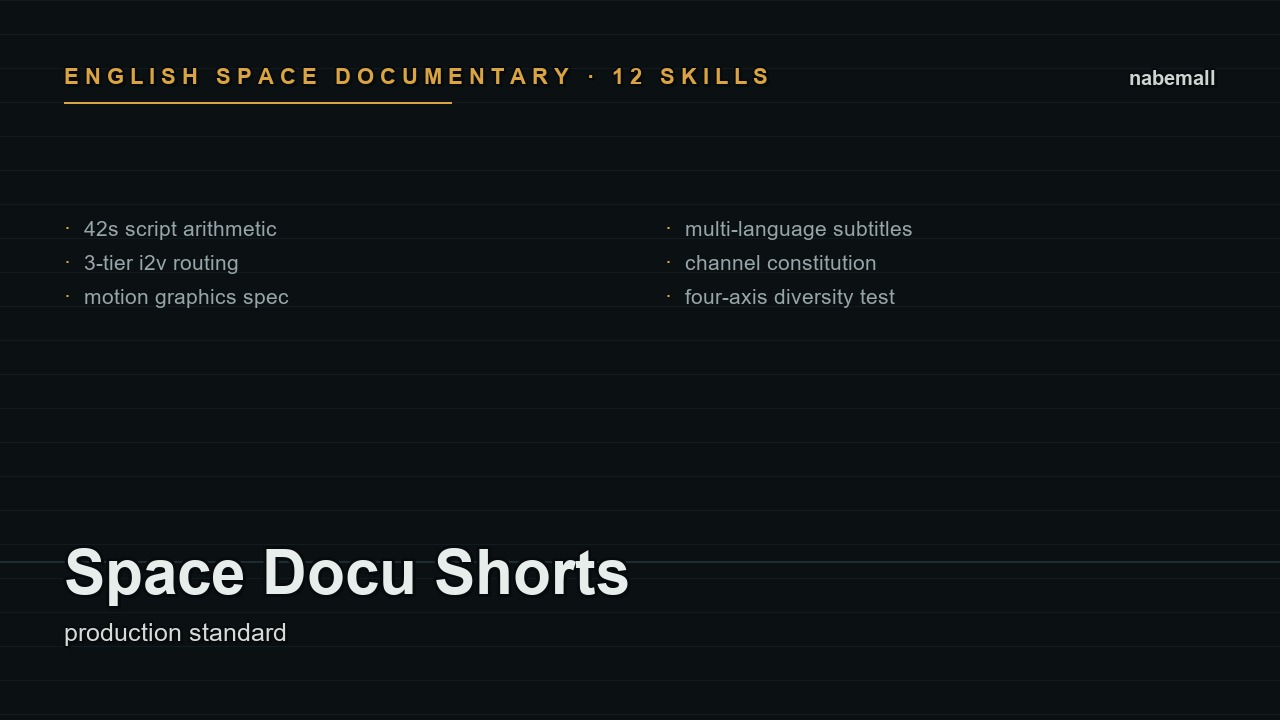
Space Docu Shorts — the English space documentary production standard
Twelve Claude Code skills for English space shorts: why the script total is 42 seconds and not 35-45, the routing table that keeps i2v credits down, and the three failures unique to a genre whose subject looks motionless.
The production standard of a running English space documentary channel, as twelve Claude Code skills.
Space is the genre where the subject appears not to move by itself. That single fact produces failures no other genre has, and they are expensive, because you only find most of them after the stills, the clips and the assembly have all been paid for.
This pack is what a working operation does instead.
—
THE ARITHMETIC THAT PAYS FOR THIS PACK
A finished short has to land between 35 and 45 seconds. So people set the script's total cut duration to 35–45 seconds, and that is wrong, because the finished file gains 1.75 seconds the script never sees: 0.35 s of tail plus a 1.4 s end card.
Work it backwards. The measured narration has to land inside 33.25–43.25 s. The TTS gate passes anything between 0.80×Σ and Σ. To be safe wherever it lands you need Σ ≥ 41.57 and Σ ≤ 43.25 — so Σ is 42 seconds, fixed. Set it to 40 and a script that passes the script gate and passes the TTS gate produces a 33.75-second file that fails QA. Set it to 44 and you get 45.75 s and fail the other end. Both are caught after every credit has been spent.
The pack states the derivation, the valid cut combinations at Σ=42 (9 through 13 cuts — 14 is arithmetically unable to hold a hook), and the word window for each.
—
THREE ACCIDENTS SPECIFIC TO THIS GENRE
1. A motionless celestial body is a dead video. A galaxy rotates about its core, a star's surface boils and throws flares, a planet spins while its clouds move at a different rate. A frame where only the camera moves gets swiped instantly — and the fix is not "raise the model tier", which spends double and changes nothing.
2. Explanatory scenes built with i2v fail. Ask a generative model for a diagram, a formula or a decoding and it returns plausible abstract patterning. Those cuts have to be 2D motion graphics, with the lettering laid on at render time with a font — because a generation model breaks the spelling.
3. Occlusion motion duplicates the subject. "The moon passes behind the planet" defeats the model's tracking and it draws a copy in front. You get two moons. The fix is cut design, not prompting; regenerating just duplicates again.
—
COST CONTROL IS A ROUTING TABLE, NOT A PREFERENCE
Every cut declares a motion tier that maps 1:1 to an engine: static drift goes to the
cheap family, orbital tracking to the fast tier, explosions and re-entry to the expensive
one. The gate is kling ≥ 50%. Both directions are errors — smearing a dynamic
cut on the cheap model, and rendering a static cut on the expensive one, which is the usual
way a credit budget disappears.
The pack also carries the order-length rule that catches people out: a 5-second hook fits the 5-second preset only in the first cut, because the crossfade compensation attaches to the front of every clip except that one. Put the 5 anywhere else and it needs 5.35 s, lands on the 10-second preset, and that single cut costs twice as much.
—
WHAT IS IN IT
Twelve skills covering topic discovery → deep research → script → TTS → stills → i2v clips → subtitles (burned-in plus multi-language tracks) → assembly and render → QA → upload, plus a channel constitution with a four-axis diversity test scored by hand.
Every skill is self-contained, carries its own self-check list, and states where its constants come from so two skills cannot disagree about the same number.
—
THIS IS THE ENGLISH-CHANNEL PACK
English runs at about 2.6 words per second and is measured in words; Korean runs at about 6.4 characters per second and is measured in characters. Put an English script through review rules built for Korean and every correct script fails, because the same meaning takes roughly twice the characters and the speaking-time estimate doubles. People who run a Korean channel and then open an English one get stuck at exactly this point.
—
HONEST DISCLOSURE — PLEASE READ BEFORE BUYING
This is a production standard and a methodology, not executable code. Claude Code carries it out, or you fold it into your own scripts; it is not a one-click program.
No outcome or revenue is promised. Channel growth depends on subject matter, consistency and the market.
Statements about AI models — moderation strictness, parameter constraints — were measured during operation and can change with model versions. Each skill includes the method for re-measuring rather than asking you to trust the number.
Generation credits for images, i2v and TTS are your own cost. The routing skill exists to reduce that cost, not to remove it.
Shorts only (9:16, 35–45 s). Mid-form and long-form run five to ten times the cut count with chapters, per-act BGM and 16:9 — a different process, sold separately.
English channels only. Running a Korean channel, the arithmetic is different.
—
REQUIREMENTS
Claude Code or a Claude agent environment · web search (both the topic and research stages depend on it, and there is no way around it) · image generation · i2v video generation · an English documentary TTS voice · ffmpeg. Licensed BGM is recommended. A translation route and the YouTube Data API are optional — the upload skill includes a manual checklist.
—
LICENCE
Producing for your own or your company's channels is covered by the base licence. Delivering to third-party clients as agency work requires a separate agency licence. Reselling, redistributing or reproducing the skill text is not permitted. Full text in LICENSE.md.
Support: questions on using the skills for 30 days from purchase, five exchanges. Environment debugging and per-project consulting are not included. Updates are for life — re-download from the purchase page.