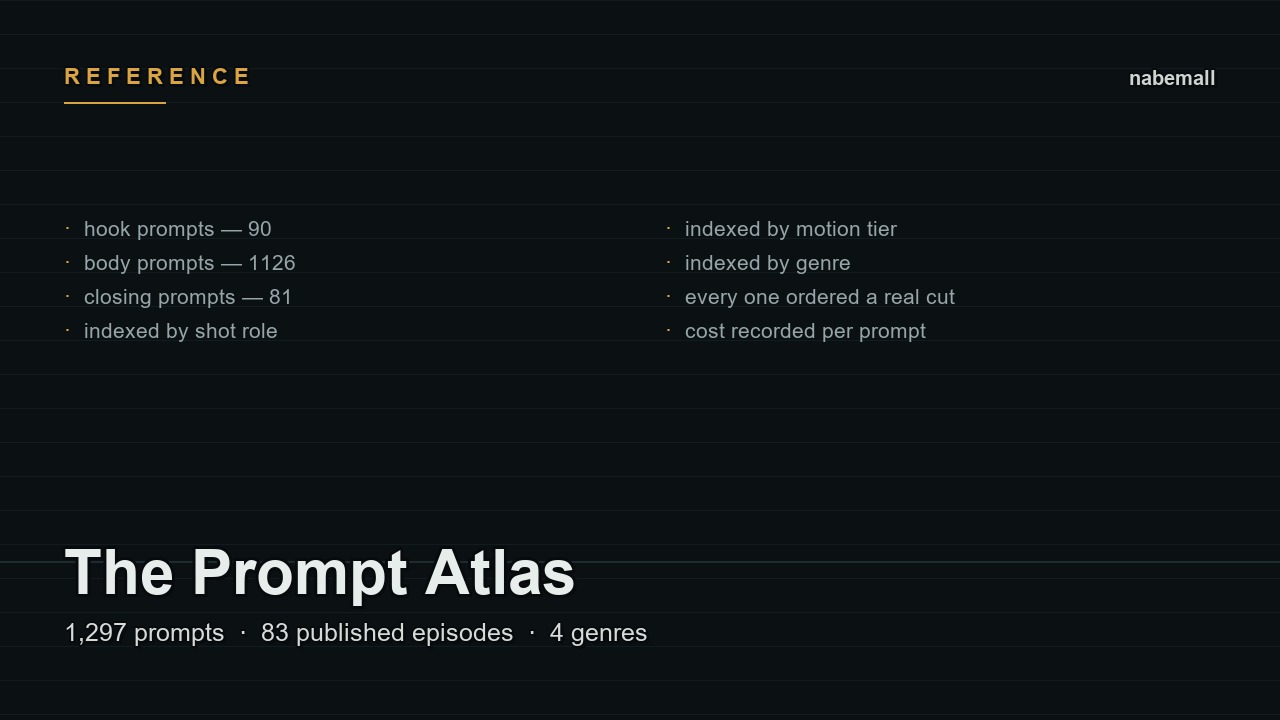
The Prompt Atlas — 1,297 production prompts, indexed by the job each shot does
Every prompt from 83 published episodes, filed by shot job — hook, body, closing — with framing, duration and the engine tier each was routed to.
Every prompt from 83 published episodes, filed by shot job — hook, body, closing — with framing, duration and the engine tier each was routed to.
What is in it
- 01-hook.md — included in the package
- 02-body.md — included in the package
- 05-closing.md — included in the package
- README.md — read this first
Claims, and how to check them
- the archive contains 7 files
check: list the zip; this count was read from it
What it does not do
- not a program — nothing here runs on its own
- generation credits are your cost
- no guarantee of an outcome, and no revenue is promised
You need already
- nothing to read it
- your own generation credits to run anything in it
files: 7formats: md, jpg, csv
1,297 prompts. Every one of them ordered a cut in a video that is live on YouTube right now.
This is not a prompt pack. It is a production corpus with an index: 83 published episodes across four genres, with every prompt filed under the job its shot had to do in the edit — hook, body, closing.
The index is the product. Two thousand prompts in a folder is a dump you will never open twice. The same prompts grouped by shot job is something you open at the exact moment you are stuck on a specific kind of cut.
WHAT IS IN IT
• 01-hook.md — 90 opening prompts. The scarcest kind, because an episode only gets one.
• 02-body.md — 1,126 prompts for the middle, where most cuts live
• 05-closing.md — 81 closing prompts, carrying the ask
• index.csv — every prompt as a row: episode, cut number, genre, role, framing, motion tier, duration, still prompt, and the motion block split into subject / action / environment
Four genres: wildlife documentary, space documentary, true-crime reconstruction, animal bond.
WHAT EVERY ENTRY CARRIES
Not just the text. Each prompt comes with the episode it belongs to, the cut number, the intended duration, the framing, and the engine tier it was actually routed to. You can see what a 4.5-second wide dynamic shot was asked for, next to what a 7-second low-motion close-up was asked for, in the same genre, by the same hand.
THREE THINGS THE CORPUS SHOWS THAT AN ARTICLE CANNOT
• Identity is locked with a positive count, never a negation. The wildlife prompts name the species, the ear shape, the coat pattern, the toe count. None of them list what the animal must not be — a forbidden thing tends to get summoned.
• Framing is written as what fills the frame, not as a shot-size name. Shot size is in the metadata because the pipeline needed it; the prompts themselves describe the picture.
• Subject, action and environment are separate lines in every motion block. Collapsing them into one sentence is where drift starts. 983 of the entries have all three.
AND ONE THING ABOUT MONEY
The motion tier is recorded on every prompt. Read the distribution and you can see what a real episode costs: the majority route to the cheap engine, and the expensive tier is reserved for the handful of cuts that genuinely need it. That ratio is most of a production budget, and it is visible here as data rather than as advice.
WHY THIS CANNOT BE ASSEMBLED BY SOMEONE ELSE
Every prompt in here was written to order a specific cut of a specific episode, and that episode exists. You cannot generate this corpus; you have to have run channels for months and kept the build folders. That is the whole moat, and it is why the entries are messy in places — they are working files, not a curated showcase.
HONEST NOTICE
• These are examples of a working grammar, not templates to paste unchanged. Genre, subject and duration all change what a prompt should say.
• Generation models change behaviour between versions, sometimes reversing it. Read this as a corpus, not as a ruleset.
• Channel names and machine paths have been removed. Everything else is verbatim, including the imperfect entries.
• Delivered as Markdown and CSV. No PDF, no video, no software.
• You may use, adapt and build on these prompts in your own commercial and personal work, including client work. You may not resell or redistribute the atlas itself.